

The recurring question to manage well your businesss in catering is how to fix the price of your recipe portions.
Obviously as a restaurant professional, you already know how important it is to control your daily costs.
When it comes to define exactly what you need to do, you need to consider several factors in developing your strategy:
Your strategy in terms of price range compared to the targeted clientele.
Your added value compared to your competitors.
The impact of competition: price charged for an equivalent quality, thenumber of close competitors.
The geographical area and the local standard of living.
The actual cost of the recipe (see article " How to calculate your recipe cost ? ")
The
three largest expenses of a restaurant are rent, employee salaries, and
food costs. In general, rent and wages do not change much from one month to
the next (I leave seasonal fluctuations aside for some activities). The
expense item that can significantly impact your selling price is the
cost of raw materials or food cost.
Only accurate knowledge of your costs allows you to determine the prices from which you start making money.
THE FOOD COST METHOD
CALCULATE THOERETICAL FOOD COST PERCENTAGE
Quite simply, the food cost percentage is the ratio of the cost of the portion or dish you sell over the selling price. The cost of the portion represents the expenses made in terms of food raw materials.
This percentage is a theoretical value that could be defined as "the theoretical percentage of food desired in a recipe".
On average, this percentage is between 25% and 35%.
DEDUCE YOUR SALE PRICE
We can therefore deduct from this percentage the unit price envisaged for the portion of your recipe with the following formula:
Unit selling price of dish = (Total cost of food ÷ Therotical Percentage of desired food cost) x 100 |
ONE EXEMPLE
Take the case of the following recipe:
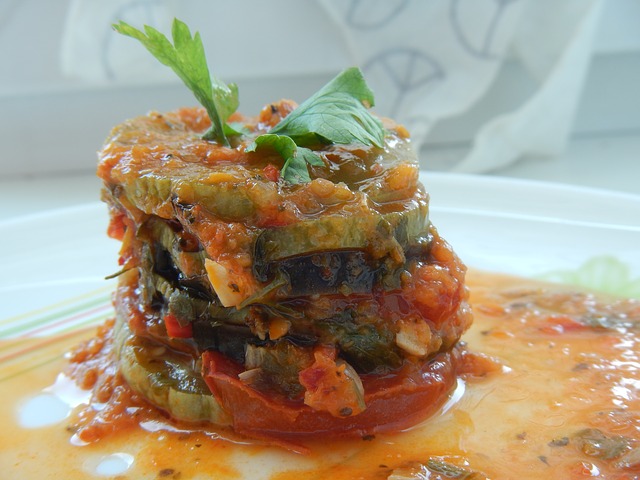

Ratatouille recipe prices and yield extracted - Ratatool
Calculation of the price according to the food cost method at 30%:
Unit
selling price for the recipe: 5.03 = Total cost of the food used: 1.51 ÷
Theoretical percentage of the desired food cost: 30%
Calculation of the price according to the food cost method at 25%:
Unit selling price for the recipe: 6.04 = Total cost of the foods used: 1.51 ÷ Theoretical percentage of the cost of food desired: 25%
The
advantage of this method is to be able to automate the sales price
calculations of your restaurant menu and to have some sort of standard
to fix its prices.
The
disadvantage of this method is that it does not take into account other
costs as well as the target margin that you target to ensure the
sustainability of your business.
It is also possible to deliberately make
choice to put more money on the ingredients (increase the theoretical
percentage food) by reducing the costs on wages or other fixed costs
(rent ...) if this is possible.
This means that you modify the other parameters of the following simplified global equation:
Selling price = (food cost + labor costs + fixed costs) + margin |
It all depends on the proposed values your restaurant put forward and what your potential customers are willing to pay.
THE CONTROL OF FOOD COST
Despite your need to regularly monitor the cost of food, in practice, it is not easy to achieve because prices fluctuate depending on external parameters (weather, breakage, seasonal variation ...) that unfortunately we can not control.
To try to calculate the overall food cost of your establishment, you can already estimate this value weekly:
List your food goods delivery received early in the week (week 1).
Make the total sum in cost of each item.
Keep an accurate listing of any other purchases made during the week.
Redo an inventory of food at the end of the week (end of week 1).
Calculate the food cost for the week with the following formula:
Theoretical Percentage of food cost = (Start Inventory + Purchases – End Inventory) ÷ Product sold |
ONE EXEMPLE
- Starting from a value of your stock at the beginning of inventory of 5000€ of food goods
- By making purchases with a weekly value of 1200$
- Take a value of your inventory at the end of the inventory of 3500$
- With an amount of sales made during the week of 9200$
- The Percentage Food Cost is calculated as:
= 2800 ÷ 9200
= 0.304 or 30.4%
WHY PERCENTAGE FOOD COST ?
It allows you to check your expenses regularly if you want to make a profit.
Have a basis of work to optimize the different items of expenses.
Better spend when buying food.
Adjust your prices on the menu according to the cost of raw materials and your profitability strategy.
Allows you to experiment with recipes and find the right profitable and popular recipe to put on the menu.
Obviously this percentage does not take into account the entire cost structure (see previous formulas) but it allows to control the food cost which is the most risky and most variable part in the current expenses of a restaurant owner.
IN CONCLUSION
The price policy of a restaurant establishment has a huge impact on its success or failure in the medium term. It is a permanent compromise between the coverage of expenses incurred and the research of a reasonable profit without sacrificing the desired quality. It can help to attract and retain loyal customers. The success of your establishment by its singularity can allow to practice higher prices than those usually practiced and therefore as a result to maximize your profits.
Ratatool allows you to calculate your food costs for each recipe on a daily basis from your ingredients, to automatically estimate your food cost percentage, gross margins of your recipe, to compose your restaurant menus (or combos), to provide USDA nutrition tags and allergerns infos to your customers for example.